
If you manage a factory, warehouse, food facility, or data center, “rodent control” usually means tradeoffs: chemicals near products, traps that require constant checking, and recurring service visits that don’t scale. Strike System is different: we focus on non-toxic rodent deterrent systems designed to make your facility inhospitable to rodents—without killing, poisoning, or disrupting operations.
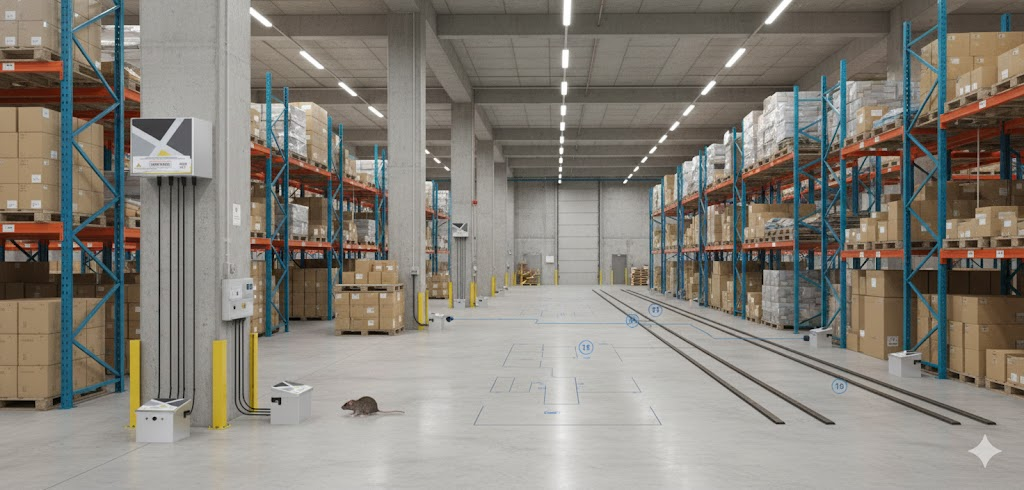
Quick Answer: What’s the Best Non-Lethal Rodent Control for Factories?
For large industrial sites, the most practical non-lethal approach is continuous deterrence that covers big square footage with minimal maintenance. Strike System provides two industrial-grade, chemical-free technologies:
- TRANSRAT Seismic Vibration Systems that transmit millions of micro-vibrations through walls and floors to drive rodents away from protected zones.
- Ultrasonic Systems that use high-frequency sound waves with adaptive frequency to help push rodents out of targeted areas.
In many facilities, seismic is the “coverage backbone,” and ultrasonic is added where extra localized pressure exists (utility rooms, wall cavities, specific bays).
What Strike System Actually Does (and Doesn’t Do)
Strike System is a technology provider for rodent deterrence—built for facilities that want to reduce risk from toxic pesticides and minimize ongoing maintenance. We deploy industrial deterrent systems designed to help prevent rodents from occupying, nesting, and moving freely in your structure.
We are not a traditional pest control company that “runs an IPM program” as the main deliverable. If you already have internal SOPs, an EHS team, or an external pest vendor, Strike System can be your non-toxic deterrent layer—especially where poisons are a liability.
Strike System Products (What You Can Install)
1) TRANSRAT Series: Seismic Vibration Systems
TRANSRAT systems use industrial-grade seismic technology that penetrates walls and floors, creating an environment rodents avoid through millions of micro-vibrations.
Key Models
- TransRat Industry — stand-alone units for facilities that want robust coverage without networking complexity.
- TransRat Diffusion — networked systems for larger sites or multi-zone control.
- CT2016 — centralized controller for managed, coordinated operation.
Why Facilities Choose TRANSRAT
- Massive coverage: up to 100,000 sq ft (model and site dependent).
- Anti-habituation design: up to 12 million vibration combinations / patterns.
- Built for harsh environments: IP67 rated (model dependent).
- Long lifecycle: up to 20-year life (model dependent).
2) Strike System Ultrasonic Systems
Strike System ultrasonic systems use high-frequency sound waves to create discomfort and encourage rodents to migrate away from protected areas. These systems are designed with adaptive frequency and are silent to humans.
Why Add Ultrasonic
- Great for targeted rooms: electrical closets, certain corridors, select enclosed zones.
- Non-toxic: no chemicals, no residue, no carcass handling.
- Pairs well with seismic: add a second deterrence mechanism where pressure is persistent.
See Ultrasonic Product Details
Seismic vs. Ultrasonic: Which Strike System Technology Is Right for You?
| Question | Best Fit | Why |
|---|---|---|
| I need coverage across floors, walls, racks, and large open bays. | TRANSRAT Seismic | Structure-borne micro-vibrations can protect large areas through building materials. |
| I’m trying to avoid habituation over time. | TRANSRAT Seismic | Designed with large pattern variability (12M combinations). |
| I want an extra non-toxic deterrent in specific rooms or enclosed zones. | Ultrasonic | High-frequency sound with adaptive frequency can supplement broader systems. |
| I need long-life, industrial durability. | TRANSRAT Seismic | Industrial specs include IP67 and long lifespan (model dependent). |
Strike System Benefits for Industrial Operators
- Non-toxic protection: helps reduce pesticide-related risk in sensitive environments.
- Designed for uptime: deterrence runs continuously without interrupting production workflows.
- Lower operational burden: “set-and-protect” deterrence reduces dependence on frequent servicing and constant trap handling.
- Scales to large facilities: built around large-area coverage claims and centralized options.
Facilities and Industries Strike System Protects
Strike System solutions are built for critical and sensitive infrastructure, including:
- Data Centers
- Manufacturing
- Food Processing
- Medical Facilities
- Military & Government
- Telecommunications
- Retail & Commercial
- Renewable Energy
How to Choose the Right Strike System Setup
- Define the footprint: total square footage, number of floors, and key rodent activity zones.
- Identify structural pathways: under-floor areas, rack rows, mezzanines, wall cavities, and service corridors.
- Select the core technology: TRANSRAT seismic for broad structural coverage; ultrasonic for targeted reinforcement.
- Decide stand-alone vs networked: single-zone sites often start with stand-alone units; multi-zone sites may benefit from diffusion/networked control and centralized management.
- Plan deployment: position units to maximize structural transmission and avoid dead zones.
Fast path: request a site assessment and get a recommended layout. Request a Free Assessment
Frequently Asked Questions
Does Strike System use poisons or kill rodents?
Strike System focuses on non-toxic deterrence—using seismic vibration and ultrasonic technologies intended to drive rodents away from protected zones rather than relying primarily on poisons.
What is the TRANSRAT system?
TRANSRAT is Strike System’s seismic vibration product line that creates an inhospitable environment for rodents through millions of micro-vibrations transmitted through floors and walls.
How much area can a Strike System solution cover?
Strike System product pages list up to 100,000 sq ft coverage for key systems (model and site dependent).
Why do patterns matter in rodent deterrence?
Rodents can adapt to static signals. Strike System highlights large pattern variability (including 12 million vibration combinations) to reduce habituation risk over time.
Do you offer ultrasonic systems too?
Yes. Strike System offers ultrasonic systems with adaptive frequency technology that are designed to be silent to humans while disruptive to rodents.
Get a Strike System Recommendation for Your Facility
If you want chemical-free rodent deterrence that scales to industrial footprints, Strike System can recommend the right mix of TRANSRAT seismic and ultrasonic systems for your layout and risk zones.