
When factory operators search for the best non-lethal rodent control, they are usually not looking for a consumer gadget or a short-term trap program. They are looking for a way to protect uptime, hygiene, equipment, and compliance across large, complex facilities. Strike System focuses on that industrial reality with chemical-free seismic and ultrasonic rodent deterrence designed for factories, warehouses, technical spaces, and other critical environments.
In practice, the strongest factory strategies combine core IPM measures such as exclusion and sanitation with facility-scale deterrence. The main non-lethal categories are exclusion and attractant reduction, seismic deterrence, and ultrasonic deterrence. The right fit depends on coverage needs, maintenance burden, sensitivity of the environment, and how rodents are using the structure. This article compares those options with an emphasis on scale, safety, and operational suitability.
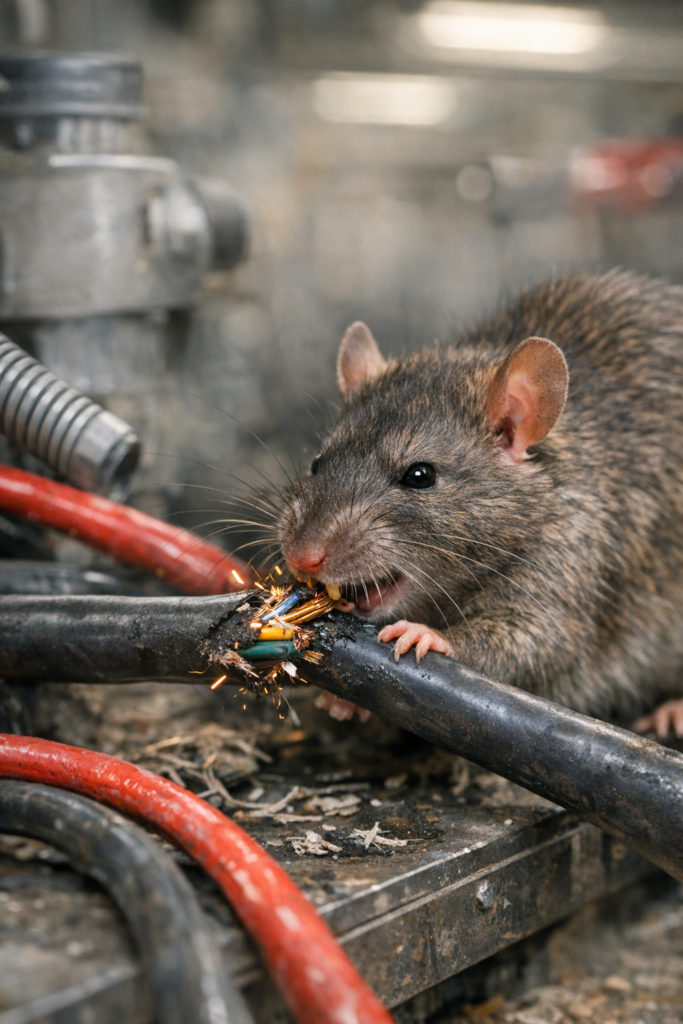
Rodents create operational risk in industrial settings. They can contaminate stored materials, damage packaging, chew insulation and wiring, occupy wall voids, and interfere with sanitation and maintenance routines. In factories, food processing plants, warehouses, labs, and data centers, that can translate into downtime, failed inspections, repair costs, and reputational exposure.
Lethal methods may remove individual animals, but they can also create new issues. Poison programs can lead to inaccessible die-off, odor, carcass cleanup, and concerns about secondary contamination in sensitive environments. Those tradeoffs are one reason many operators evaluate non-toxic approaches alongside conventional pest-control methods. The EPA guidance on rodenticides is relevant context for facilities weighing those risks.
Humane rodent control is often more sustainable when it is built around deterrence rather than repeated removal alone. Long-term control depends on making the site less hospitable, not just reducing the current population. For industrial buyers, that is typically a practical decision tied to hygiene, environmental responsibility, and fewer recurring interventions.
What non-lethal rodent control options are available for factories?
Most industrial sites benefit from a layered approach. Start with exclusion: seal penetrations, tighten dock and door discipline, and address utility entries. Add sanitation and attractant reduction: improve waste handling, reduce clutter, and remove food and nesting opportunities. Monitoring remains important as well, especially around loading zones, storage areas, utility corridors, and perimeter transitions.
Where many facilities need added protection is large-scale deterrence. Seismic deterrence works through structural surfaces. Ultrasonic deterrence works through enclosed airspace. Neither replaces basic IPM, but both can strengthen protection where poison and trap servicing alone are not a strong operational fit.
Evaluation criteria matter. Industrial buyers should look at coverage area, anti-habituation design, maintenance needs, silent operation, suitability for electrical rooms or production areas, and fit for compliance-driven environments. They should also distinguish engineered industrial systems from commodity plug-in devices. In food and hygiene-sensitive settings, broader sanitation expectations under the FDA Food Code are also part of the decision context.
Seismic deterrence for large facilities: how the TRANSRAT Series works
For broad structural coverage, the TRANSRAT Series is Strike System’s primary seismic solution. It is manufactured in Italy by Leonardo Soluzioni, a company with 40 years in the industry. Rather than relying on poison or capture, TRANSRAT generates micro-vibrations through floors and walls that create perceived instability and trigger rodents’ flight instinct. The goal is to make the structure less suitable for nesting, movement, and repeated occupancy.
This mechanism is particularly relevant in factories, warehouses, production zones, and other interconnected footprints where rodent pressure is not confined to a single room. Because activity often follows slabs, wall lines, service corridors, and storage perimeters, structural deterrence can support protection at building scale.
Key specifications include coverage of up to 100,000 sq ft, 12 million vibration combinations to help reduce habituation, an IP67 rating, and an expected 20-year lifespan. The line is also HACCP compliant and CE certified. Relevant models include TransRat Industry, TransRat Diffusion, and the CT2016 controller for coordinated deployments.
For facilities evaluating lifecycle value, those specs matter. High coverage and long service life can support lower ongoing intervention requirements than recurring consumable-based programs, especially in large industrial footprints.
Ultrasonic protection for targeted and sensitive spaces: how the US2004 Series fits
The US2004 Series is designed for targeted deployment in enclosed or sensitive spaces. It is generally best suited to electrical rooms, control rooms, switchgear areas, IT rooms, utility closets, smaller storage zones, and similar technical environments where silent operation and maintenance-free performance are priorities.
Ultrasonic products often have mixed reputations because many consumer plug-ins are underpowered, poorly positioned, or too static in output. Industrial ultrasonic systems should be evaluated differently. The US2004 Series uses adaptive frequency technology to help reduce habituation, operates silently, and is designed to be maintenance-free in normal use.
Its coverage reaches up to 10,000 sq ft, depending on room geometry and deployment design. Like TRANSRAT, the US2004 Series is HACCP compliant and CE certified. Relevant models include US2004 Self-Contained, US2004 Diffusion, and the CT2008 controller.
In many facilities, ultrasonic is not the whole answer. It is often the right tool for enclosed rooms or as supplemental protection within a broader, site-specific design.
Which is best for your factory: seismic, ultrasonic, or a layered approach?
The best choice depends on building layout, rodent movement patterns, and which areas carry the highest business risk. Broad, interconnected structures often align well with seismic coverage. Enclosed technical spaces often align well with ultrasonic coverage. Many sites benefit from both.
| Criteria | TRANSRAT Series | US2004 Series |
|---|---|---|
| Primary mechanism | Micro-vibrations through floors and walls triggering the flight instinct | Adaptive ultrasonic output in enclosed airspace to discourage occupancy and activity |
| Coverage | Up to 100,000 sq ft | Up to 10,000 sq ft |
| Best environment | Factories, warehouses, production floors, broad industrial footprints | Electrical rooms, control rooms, technical spaces, enclosed zones |
| Maintenance | Maintenance-free | Maintenance-free |
| Audibility | Silent in operation | Silent in operation |
| Typical deployment | Facility-wide structural deterrence | Targeted or supplemental room-by-room protection |
As a general rule, choose seismic for broad structural coverage and ultrasonic for targeted enclosed rooms. A layered design is often appropriate because industrial sites tend to have both structural travel routes and localized high-risk spaces.
What to look for in an industrial non-lethal rodent control vendor
Industrial buyers should expect more than a product list. A credible vendor should be able to review floorplans, map likely coverage, identify pressure points, and recommend specific products based on layout and use case. That is especially important in facilities with multiple building types, technical rooms, or strict hygiene requirements.
Certifications and engineering details matter. HACCP compliance and CE certification are useful trust signals for hygiene-sensitive environments. ISO-oriented quality context may also matter in procurement review. Beyond certifications, buyers should ask about controller architecture, ingress protection, anti-habituation features, installation standards, and expected service life.
Strike System’s position in this category is tied to specialization. As the North American industrial partner for Leonardo Soluzioni, it brings Italian manufacturing heritage, 40 years of industry experience, product-specific deployment planning, and networked controller options for complex facilities. Maintenance-free operation also changes lifecycle economics compared with recurring bait, trap, and consumable programs.
Procurement and facility teams should ask for coverage mapping, floorplan review, and clear recommendations on where TRANSRAT Series, US2004 Series, or a combined design is likely to fit best.
Implementation in real-world factory environments
Deployment usually starts with a site assessment. Typical inputs include floorplans, historical pressure points, utility penetrations, loading zones, production lines, storage areas, electrical rooms, and maintenance spaces. That helps determine whether the rodent issue is mainly structural, localized, or mixed.
Large facilities are often rolled out in phases. A food processing plant may prioritize receiving, dry storage, packaging, and utility corridors. A data center may focus on electrical rooms, cable pathways, perimeter structure, and backup power areas. Warehouses, laboratories, manufacturing plants, agricultural properties, and government or military sites each require different zoning logic.
Electronic deterrence works best as part of a broader strategy. Exclusion, sanitation, and monitoring still matter. The role of TRANSRAT Series and US2004 Series is to add continuous, chemical-free deterrence where ongoing protection is operationally important. Readers who want to review applications, product lines, or industry pages can start with Strike System industrial rodent deterrent solutions.
FAQ
What is the best non-lethal rodent control for factories?
For many facilities, the strongest approach is layered: exclusion and sanitation combined with industrial deterrence. TRANSRAT Series is typically the better fit for broad structural coverage, while US2004 Series is typically better for targeted enclosed spaces.
How does the TRANSRAT Series deter rodents without poison or traps?
It generates micro-vibrations through floors and walls, creating perceived instability that can trigger rodents’ flight instinct and discourage nesting and movement.
Is ultrasonic rodent control effective in factories, or only in small spaces?
Industrial ultrasonic can be useful in factories when it is applied in the right environments. The US2004 Series is generally best for enclosed rooms and technical spaces rather than open, sprawling structures.
What makes the US2004 Series different from consumer plug-in ultrasonic devices?
The US2004 Series is designed for industrial deployment, with up to 10,000 sq ft of coverage, adaptive frequency technology, silent operation, maintenance-free performance, and controller-based options.
Which Strike System product is better for electrical rooms or control rooms?
The US2004 Series is usually the better fit for electrical rooms, control rooms, and similar enclosed technical spaces.
Can seismic and ultrasonic rodent deterrents be used together in one facility?
Yes. Many sites use TRANSRAT Series for structural coverage and US2004 Series for targeted rooms that need additional protection.
Are TRANSRAT Series and US2004 Series safe for food processing facilities?
Both product families are HACCP compliant and CE certified, which supports use in food processing and other hygiene-sensitive environments when properly specified.
Do humane rodent deterrent systems require ongoing maintenance or consumables?
No recurring poison, bait, or trap consumables are required. Both TRANSRAT Series and US2004 Series are designed for maintenance-free operation.
How much area can the TRANSRAT Series cover?
Up to 100,000 sq ft, depending on building design and deployment layout.
How much area can the US2004 Series cover?
Up to 10,000 sq ft, depending on room geometry and installation design.
Will non-lethal rodent deterrence help reduce dead-rodent cleanup and odor issues?
It can help reduce those issues because deterrence-based systems do not rely on poisoning rodents inside inaccessible areas.
How do I know whether my factory needs seismic coverage, ultrasonic coverage, or both?
That depends on layout, rodent pathways, and high-risk zones. Broad structural activity often points to TRANSRAT Series, enclosed technical rooms often point to US2004 Series, and mixed environments often benefit from both.
Conclusion
The best non-lethal rodent control for factories depends on facility layout, risk profile, and operational priorities. In many industrial environments, however, industrial-grade seismic and ultrasonic deterrence are among the strongest humane options because they can scale, avoid chemicals, and support a maintenance-free strategy. Strike System brings those options together through the TRANSRAT Series and US2004 Series, backed by Italian manufacturing heritage, HACCP-compliant and CE-certified product lines, and site-specific design support.
For a site-specific recommendation, request a free site assessment from Strike System at 323-352-2766 or visit strikesystem.com.