
Commercial and industrial facilities attract rodents with far greater frequency than most operations teams account for in their risk planning. Large buildings supply everything multiple mouse species need simultaneously, so before any protection strategy can hold, the species present has to be correctly identified. Behavior, entry routes, and health risks differ sharply from one mouse to the next.
In this guide, we will cover the six most documented in U.S. facilities.
Key Takeaways
- Large commercial facilities can host several mouse species simultaneously, each occupying a different zone based on heat, food access, and harborage.
- Six species are regularly documented in U.S. facilities, each with a distinct entry route, physical profile, and health risk.
- Physical evidence appears long before any sighting during operational hours; knowing the indicators changes how early a problem gets caught.
- Food processing plants, data centers, cold storage warehouses, and power generation facilities each create conditions that favor specific species.
- Correctly identifying the mouse present determines the right protection response — the same approach does not hold across all six.
Why Do Industrial Buildings Attract So Many Different Types of Mice?
Large commercial facilities rarely host just one mouse species. Several can occupy the same building at once, because different zones satisfy different survival needs simultaneously.
Every mouse needs three things: heat, food access, and an undisturbed place to nest. Industrial buildings deliver all three, typically in separate areas under the same roof.
- Loading docks and delivery bays provide open entry points, along with food debris from packaging and daily foot traffic.
- Electrical rooms and server vaults generate continuous heat, drawing species that prefer warm, enclosed nesting zones.
- Insulated wall cavities and ceiling spaces offer undisturbed harborage well away from daily activity.
- Storage areas with palletized goods combine food contact and nesting material in a single location.
A warehouse, food processing plant, or data center can host multiple types of mice in parallel, each occupying a different part of the facility. That’s why knowing the species comes before any other decision.
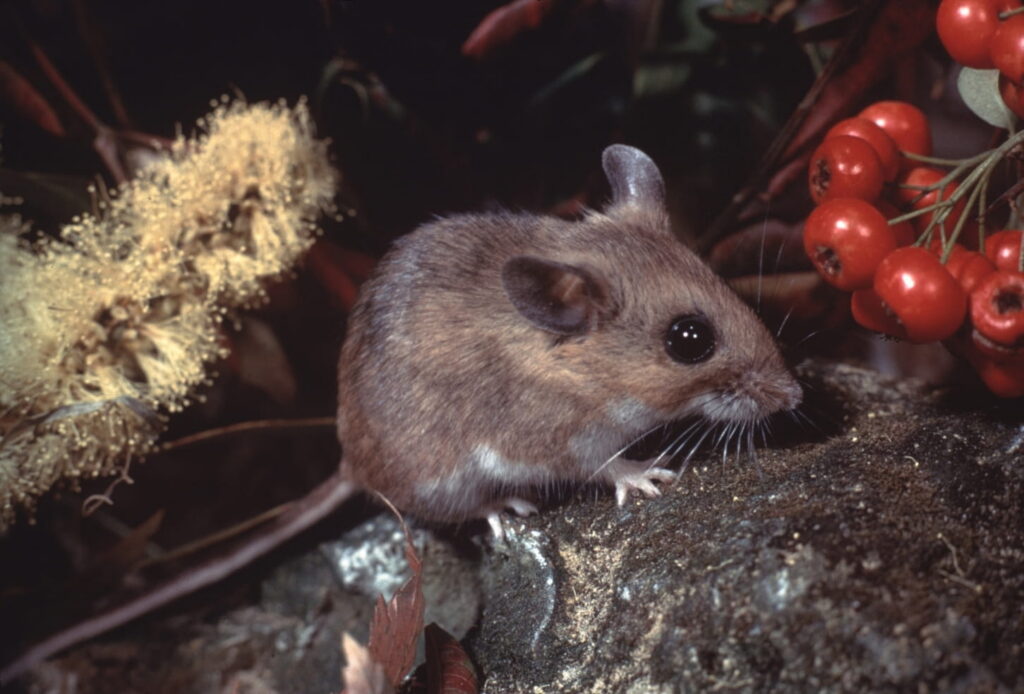
What Are the Different Types of Mice Found in Commercial & Industrial Buildings?
Six mouse species account for the vast majority of commercial rodent activity across the United States. Each one is profiled below with physical identification markers, behavior inside facilities, and the specific risks it carries.
House Mouse
The House Mouse is the most prevalent commercial rodent in the country. No other species has adapted as completely to human-built environments, and none nests as consistently close to heat-generating equipment.
| Feature | Detail |
| Body length | 2.5 to 3.75 in |
| Color | Dusty gray to light brown; cream belly |
| Tail | Hairless; roughly equal to body length |
| Key marker | Uniform coloring, pointed snout, large ears |
House mice are active year-round. They don’t leave for seasonal shifts and don’t require much to establish. A dime-sized gap is enough to enter; shredded cable insulation or drawer lining is enough to nest.
Inside facilities, they concentrate near wall voids behind machinery, inside electrical control panels, and within ceiling cavities above break rooms and food prep areas.
The structural risk is frequently underestimated. Continuous gnawing on wiring insulation creates fire conditions inside walls that go undetected for months.
On the health side, this species is associated with Salmonella, leptospirosis, and hantavirus. A single female produces up to 10 litters per year, meaning a small population compounds quickly.
Deer Mouse
The Deer Mouse is visually distinct and behaves in ways that carry specific operational consequences.
| Feature | Detail |
| Body length | 3 to 4 in |
| Color | Brown or gray back; sharply defined white belly and feet |
| Tail | Bicolored; darker on top, lighter underneath |
| Key marker | Large, rounded eyes and ears; strong two-tone contrast |
Unlike the House Mouse, the Deer Mouse avoids active, heated zones. It gravitates toward attics, roof insulation, rarely accessed storage rooms, and wall cavities far from daily foot traffic.
Facilities bordering open land carry the highest exposure: warehouses near fields, power substations, and distribution centers adjacent to undeveloped areas.
The primary concern is hantavirus pulmonary syndrome. Transmission doesn’t require direct contact with the animal. Disturbing dried droppings or nesting debris in a confined, poorly ventilated space during a maintenance task or storage audit can release aerosolized particles. Confirmed presence demands a decontamination response that goes significantly beyond what standard rodent removal covers.

White-Footed Mouse
The White-Footed Mouse is the dominant woodland-adjacent species across eastern and central U.S. industrial corridors. It’s also the one most likely to appear in overhead building zones that other species rarely reach.
| Feature | Detail |
| Body length | 3 to 4 in |
| Color | Reddish-brown back; clean white feet and belly |
| Tail | Bicolored; slightly shorter relative to body than Deer Mouse |
| Key marker | Distinctly white feet; warm reddish-brown coat |
This species climbs. Roof voids, upper warehouse racking, ceiling plenum spaces, and overhead cable trays are all documented nesting zones. Entry typically originates from wooded perimeters, and multi-story buildings or facilities with extensive overhead cable infrastructure face the greatest exposure.
The White-Footed Mouse is a primary carrier of Lyme disease-transmitting ticks. The health risk differs from the airborne concern associated with Deer Mice, but maintenance personnel working in upper building zones face real occupational exposure.
Gnaw damage in overhead cable management systems is also harder to locate and more expensive to repair than damage at ground level.
Field Mouse
The Field Mouse is a practical category covering several closely related outdoor mice that migrate into commercial buildings from surrounding land. In pest management practice, the term applies to the Apodemus group and similar grassland or woodland species that move inward seasonally.
| Feature | Detail |
| Body length | 3 to 4 in |
| Color | Warm yellowish-brown back; white or buff belly |
| Tail | Often longer than body |
| Key marker | Larger eyes and ears than House Mouse; distinctly yellow-brown tone |
Infiltration pressure is seasonal. The most concentrated entry occurs during autumn harvest and the first sustained cold period, when food sources in surrounding fields disappear.
Distribution centers, food processing plants, and grain storage facilities on the edge of agricultural land are the primary targets for this mouse species group.
Field mice chew through product packaging to reach stored goods and contaminate raw materials on direct contact. They are regularly misidentified as juvenile Norway rats in the field, which delays the correct response and allows the population to establish.
Salmonella and leptospirosis are the main health concerns, transmitted through contact with droppings, urine, or contaminated surfaces.
Western Harvest Mouse
The Western Harvest Mouse is the smallest of the types of mice covered here, and size is precisely what makes it a specific liability in food and grain storage environments.
| Feature | Detail |
| Body length | 2 to 3 in |
| Color | Grayish-brown back; pale buff or white belly |
| Tail | Long and slender |
| Key marker | Distinctly grooved upper incisors; smallest body of listed species |
Found across the western and central U.S., this species nests directly inside stored products rather than in surrounding structures.
Grain sacks, bagged dry goods, and pallet stacks are primary nesting sites. Its small frame allows it to access packaging seams and structural gaps that larger mice cannot reach, including sealed areas that routine inspections overlook.
In HACCP-regulated environments, the contamination exposure is direct: droppings and urine deposited inside product packaging or bulk storage containers. Detection frequently comes later than with larger species, because the physical evidence is proportionally smaller and easier to miss during standard facility checks.
Cotton Mouse
The Cotton Mouse covers a defined geographic corridor and enters facilities through routes that distinguish it from every other species in this guide.
| Feature | Detail |
| Body length | 3.5 to 4.5 in |
| Color | Dark brown back; white belly |
| Tail | Moderately long; bicolored |
| Key marker | Larger and darker than the Deer Mouse; southeastern U.S. only |
Its range runs from Florida north through Virginia, across Tennessee, Mississippi, and the Gulf Coast industrial belt. This species swims. Entry through floor drains, below-grade pipe penetrations, and dock drainage channels sets it apart from the other five, all of which rely on above-grade structural gaps.
Manufacturing plants, warehouses, and chemical processing facilities near wetland or wooded areas in the Southeast carry the highest exposure.
The Cotton Mouse is a vector for spotted fever group rickettsiae. The pathogen draws less attention than hantavirus in industry literature, but the occupational health risk for workers in ground-floor and basement zones of affected facilities is documented.
What Signs Confirm a Mouse Infestation Before It Becomes a Facility-Wide Problem?
Physical evidence appears well before a mouse is ever seen. By the time visual sightings happen during active hours, the population is already established.
Six physical signs reliably point to an active mouse presence:
- Droppings — dark and moist means recent (gray and crumbling means older). Clusters along a wall or beam reveal a travel route, not just a location.
- Gnaw marks — light-colored and rough-edged on fresh damage (darker on older). Marks on wiring indicate nesting nearby.
- Grease trails — mice run the same paths repeatedly. Dark smear lines along baseboards, pipe runs, and structural beams map the activity precisely.
- Acoustic evidence — scratching and movement in wall cavities or ceiling spaces, most pronounced between 10 PM and 4 AM.
- Nesting material — shredded insulation, foam, or fabric inside machinery housings or sealed storage areas.
- Ammonia odor — builds gradually in poorly ventilated spaces where a population has been active for an extended period.

Which Industrial Facility Types Face the Highest Risk of Mouse Activity?
Certain operations carry structurally higher exposure, and the risk comes from the facility’s core function rather than negligence or maintenance gaps.
- Food processing and packaging plants combine a continuous food source with HACCP compliance requirements. A single confirmed sighting can trigger a third-party audit or a production halt.
- Data centers and server facilities generate sustained heat across every floor level, creating year-round nesting conditions in cable voids and raised flooring systems. Gnaw damage to fiber or power cabling rarely has a low-cost fix.
- Cold storage and distribution warehouses run high inbound freight volume through loading areas daily, which provides repeated entry opportunities regardless of how well seals are maintained.
- Power generation and utility facilities often include large, rarely accessed mechanical rooms with thick pipe insulation. These spaces can support an established population for a long time before any evidence surfaces at the operational level.
- High-rise commercial buildings face pressure from multiple floors simultaneously, with roof voids and elevator shafts functioning as internal travel routes between levels.
Does Knowing the Exact Mouse Species Change How a Facility Should Be Protected?
Directly, yes. The decontamination protocol for a confirmed Deer Mouse presence is categorically different from a House Mouse response. A White-Footed Mouse entering through roof voids requires a different structural audit than a Cotton Mouse coming through below-grade drainage. Species identity determines where to inspect, which entry points to prioritize, and what health risks to communicate to the operations team.
Reactive approaches (traps, bait stations, periodic treatments) address individual animals, not the conditions that brought them in. At the scale of a large commercial or industrial facility, that gap between reaction and prevention is where repeated infestation cycles live.
Structural deterrence that makes a facility hostile to rodents at the sensory and environmental level is what breaks the cycle. We at Strike System offer a free facility assessment to identify exactly where different types of mice are gaining access and what a long-term protection plan requires for your specific building.
FAQ
Yes. Different species occupy different zones within the same facility simultaneously, each responding to the specific conditions in their area — heat output, food proximity, foot traffic levels, and structural access points.
No. Deer Mice are the primary hantavirus reservoir, which requires airborne precautions during any decontamination work. White-Footed Mice carry Lyme disease-transmitting ticks. Field and House Mice are associated with Salmonella and Leptospirosis through surface and product contact. Cotton Mice carry spotted fever group rickettsiae. Each species presents a distinct exposure profile.
A single female House Mouse produces up to 10 litters per year, with five to six pups per litter. Under stable facility conditions with consistent food access and undisturbed harborage, a small founding population can reach several hundred individuals within a few months.
Droppings are the most reliable differentiator: mouse droppings measure roughly 3 to 6 mm with pointed ends, while rat droppings are 12 to 20 mm with blunt or capsule-shaped ends. Entry points also differ; mice exploit gaps from 6 to 7 mm, while rats require at least 20 mm, so the size of gnaw openings in walls or pipe penetrations helps confirm which rodent is present.
Confirmed rodent activity is a direct violation of HACCP prerequisite programs and a critical finding in FDA and USDA inspections. Even indirect evidence — droppings near production lines, gnaw marks on packaging — can result in a hold, a mandatory deep clean, or a formal corrective action requirement depending on the severity and location of the finding.