
- The Hidden Gaps in Commercial Rat Control Services Today
- Why Industrial Rodent Control Tech Must Change by 2026
- What Most Miss About Ultrasonic Gadgets in Commercial Sites
- Inside Strike System Chemical-Free Industrial Rodent Control
- Where This Tech Beats Traditional Commercial Rat Control
- How to Choose 2026 Ready Rodent Control for Your Facility
- Short Glossary of Key Terms
- FAQ: 2026 Industrial and Commercial Rodent Control
The Hidden Gaps in Commercial Rat Control Services Today
Look at online reviews on platforms like Yelp or threads in Reddit’s r/pestcontrol community and the same complaints appear repeatedly:
- Persistent rodent sightings even after “treatment”
- Strong odors from baited carcasses in walls and ceilings
- Technicians swapping bait stations but not solving the root problem
- Emergency callbacks during nights or weekends
These are symptoms of a model focused on removal and kill counts, not on creating an environment where rodents do not want to enter or stay in the first place.
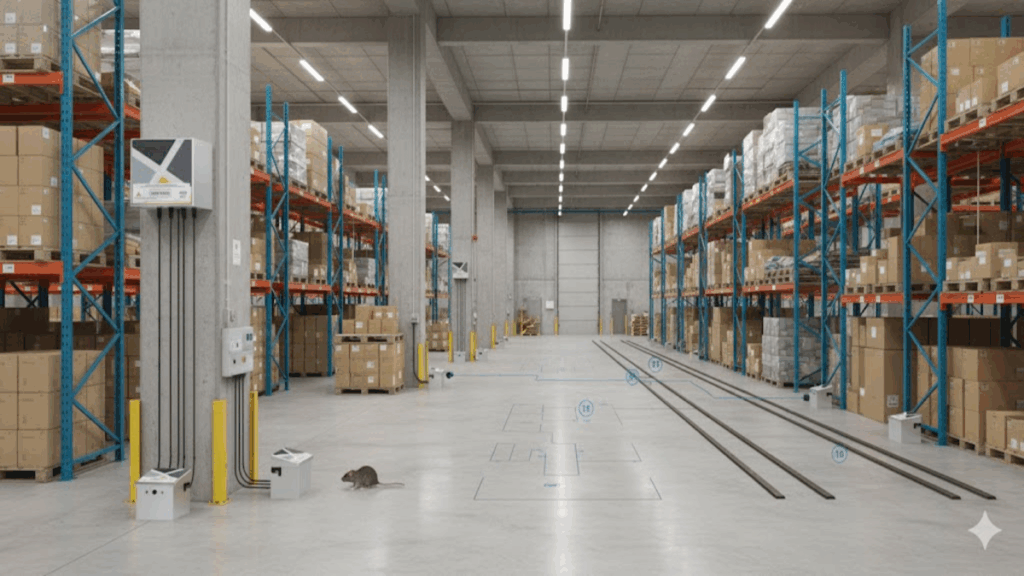
Traditional Service vs Permanent Prevention
Most mainstream commercial rodent control follows a similar pattern:
- Inspect site and identify droppings, gnaw marks and access points
- Deploy bait stations and mechanical traps
- Schedule recurring visits to refresh bait, collect carcasses and reset traps
That can be enough for a small retail shop or office that can tolerate occasional disruptions. But for a data center, pharmaceutical lab, high-throughput warehouse or food processing plant, it leaves major gaps:
- Protection is only as good as the last visit. Between technician visits, new rodents can enter, feed unobserved and die in inaccessible voids.
- Dead rodents create new hazards. Decomposition produces strong odors, fluids and potential contamination risks, particularly in food and pharmaceutical environments.
- Kill-and-replace never ends. Rodents reproduce quickly. Baiting repeatedly treats the symptom, not the structural attractiveness of the facility.
Why Critical Infrastructure Needs Stricter Standards Than Retail
For critical infrastructure and food sectors, the risk profile is far more severe than a lost box of inventory or a bad online review. Rodents can:
- Compromise clean rooms and sterile zones
- Chew through network cables and electrical conduits, impacting uptime
- Contaminate raw ingredients and finished product
- Trigger regulatory non-conformances during audits
Regulatory and guidance bodies such as the U.S. Food and Drug Administration (FDA) and food safety schemes like HACCP require systematic, preventive controls for pests in food facilities (see fda.gov for current guidance). Data centers and defense contractors operate under strict continuity and physical security requirements. In these environments, every dead rodent in a drop ceiling or behind a rack is an avoidable incident.
Definition Box: Industrial Rodent Control Technology vs Basic Pest Control
| Aspect | Basic Pest Control | Industrial Rodent Control Technology |
|---|---|---|
| Model | Service-based model focused on periodic visits | System-based model focused on creating a persistent, hostile environment for rodents |
| Emphasis | Killing and removing rodents already inside | Preventing establishment and movement, not just removal |
| Tools | Bait boxes, snap traps, glue boards, occasional exclusion work | Fixed seismic and ultrasonic deterrent devices, networked controllers, monitored coverage design |
| Approach | Reactive to reported sightings and activity | Proactive, always-on protection aligned with operational and audit requirements |
Why Industrial Rodent Control Tech Must Change by 2026
Industrial operations are under more pressure than ever from three directions:
- Tougher audits and compliance: Food safety schemes (HACCP, BRCGS, SQF), pharmaceutical GMP expectations, and internal EHS audits are tightening scrutiny of pest programs, documentation and chemical use.
- ESG and sustainability targets: Many organizations have formal ESG goals that discourage rodenticides, secondary poisoning of wildlife and unnecessary animal suffering.
- Continuous operations: Data centers, logistics hubs, cold storage facilities and national restaurant chains operate essentially 24/7. Routine shutdowns or emergency service visits are more expensive and less acceptable.
In this context, relying on poisons and traps as the primary barrier to rodents introduces new business risks.
Key Risks from Poisons, Traps and Carcasses in Critical Environments
For industrial and food-related facilities, traditional control methods can introduce problems such as:
- Odors and contamination risk from decomposing carcasses in walls, ceilings and equipment chases
- Secondary poisoning of non-target animals (pets, raptors, scavengers) when poisoned rodents move outside
- Blood and bodily fluids near sensitive production or storage areas
- Worker discomfort or ethical concerns handling dead animals
- Increased audit scrutiny due to chemical inventories and bait logs
- Possible product recalls or regulatory findings if carcasses or droppings are discovered in production zones
Resources like the CDC (cdc.gov) and many state health departments highlight the disease and contamination risks associated with rodent infestations and carcass decomposition. In regulated facilities, these risks are tied directly to brand reputation and license to operate.
Why 24/7 Operations Need 24/7 Chemical-Free Protection
When your facility never truly “closes,” your pest defense cannot either. A technician who visits once or twice per month cannot match the persistence of rodents exploring your site every night.
Industries such as:
- Data centers and server farms
- Food and beverage processing plants
- Cold storage warehouses and logistics hubs
- Biotech and medical laboratories
- Agricultural storage and animal feed operations
- Defense and aerospace facilities
need a rodent barrier that:
- Runs silently, 24/7, without disrupting staff or equipment
- Protects without using toxins that could compromise product integrity or ESG goals
- Can be documented and justified to auditors as part of a preventive control program
This is where properly engineered ultrasonic and seismic deterrent systems come into play. Unfortunately, most conversations about “ultrasonic pest control” focus on cheap gadgets that are not designed for industrial realities.
What Most Miss About Ultrasonic Gadgets in Commercial Sites
If you search “ultrasonic pest repeller warehouse does it work” on Reddit, you will find pages of skepticism. Many facility managers have tried $20 plug-ins only to see rodents ignore them or quickly return.
The problem is not the underlying physics. It is the mismatch between consumer devices and complex, noisy commercial spaces.
Why Consumer Plug-Ins Fail in Large, Noisy Buildings
Small retail ultrasonic devices are typically:
- Designed for one small room, not a 200,000 square foot warehouse
- Fixed at one or two frequencies that rodents can adapt to
- Not calibrated to the acoustic properties of concrete, steel and high ceilings
- Uncoordinated, so there are gaps and “quiet corridors” where rodents can move freely
Layer in constant ambient noise from HVAC, conveyors, forklift traffic and refrigeration, and a simple plug-in can easily become background noise that rodents learn to ignore.
What “Industrial” Seismic and Ultrasonic Systems Actually Mean
Proper industrial rodent deterrent technology is engineered very differently. It combines:
- Seismic deterrents: Devices mounted to structures (walls, beams, shelving, machinery bases) that send controlled micro-vibrations through the material. Rodents, which are extremely sensitive to ground tremors, experience this as an uncomfortable, unsafe surface and avoid it.
- Ultrasonic deterrents: Emitters that project high-frequency sound waves above the range of human hearing. When properly specified, these create an acoustic barrier that rodents find intolerable, discouraging them from entering or nesting.
- Networked controllers: Central control units that synchronize devices, adjust output zones and allow technicians to tune the system for coverage and effectiveness.
The Role of Adaptive Frequency and Professional Placement
Static frequency devices are easy for rodents to habituate to. Industrial systems address this with:
- Adaptive frequency patterns: Emission frequencies and pulse patterns that vary over time, making it difficult for rodents to adjust.
- Coverage design: Engineering surveys that map reflective surfaces, shadow zones and critical pathways, followed by strategic placement of emitters and seismic nodes.
- Integration with existing IPM: Coordination with sanitation, exclusion and operations so the deterrent layer complements rather than conflicts with other controls.
Without this level of design and adaptation, “ultrasonic” is just a buzzword on a box. With it, you gain a non-lethal barrier that works with the structure of your facility instead of fighting against it.
Inside Strike System Chemical-Free Industrial Rodent Control
Strike System focuses precisely on this industrial, engineered approach.
At a high level, Strike installations use Italian-engineered hardware that combines:
- Seismic vibration modules: Attach to structural elements like walls, columns, racks and equipment frames. These introduce low-intensity, carefully modulated vibrations that rodents perceive as constant disturbance. It is like turning your key structures into surfaces that never “feel safe” to climb, nest in or crawl along.
- Ultrasonic emitters: Project high-frequency sound into defined zones such as production lines, storage aisles, ceilings and perimeter areas. Humans do not hear it, but rodents experience a dynamic, uncomfortable sound field that drives them to seek quieter territory.
- Networked, adaptive controllers: Coordinate all devices. They vary frequencies and patterns, avoid static emissions and can be adjusted to the size, layout and sensitivity of each facility.
This system:
- Operates silently in the background 24/7
- Uses no poisons, baits or mechanical kill devices
- Avoids creating dead rodents inside walls, ceilings or equipment
- Fits within environmentally responsible and humane control expectations
Hardware is designed and manufactured in Italy by Leonardo Soluzioni, and Strike System is the exclusive North American partner for this technology. The components are built for demanding industrial environments and carry certifications such as HACCP, CE and ISO, which supports alignment with food safety and quality management systems.
Sectors that use this approach include:
- Food and beverage processing
- Warehousing and logistics
- Agricultural and feed storage
- Healthcare and laboratories
- Data centers and telecommunications facilities
- Hospitality and large restaurant brands
Strike System’s solutions are trusted by national brands such as Buffalo Wild Wings, who need to protect kitchens, storage and guest areas without relying entirely on poisons or traps.
For operations, EHS and food safety leaders, the value is straightforward: a preventive, chemical-free layer of protection that does not depend on constant human intervention.
Where This Tech Beats Traditional Commercial Rat Control
Traditional commercial services are not going away, nor should they. Exclusion work, sanitation, monitoring and, in some cases, targeted trapping will always have a place in integrated pest management.
The decision is not “either pest control or technology” but whether your facility continues to rely on poisons and periodic trap checks as the primary barrier, or uses industrial deterrent technology as the backbone with services as support.
Comparison Table: Legacy Commercial Rat Services vs Strike System Deterrence
| Aspect | Legacy Commercial Rat Services | Strike System Deterrent Technology |
|---|---|---|
| Primary approach | Kill and remove rodents already inside using bait and traps | Prevent rodents from entering or settling using seismic and ultrasonic deterrent “walls” |
| Onsite chemicals | Regular use of rodenticides in bait stations | Chemical-free, no rodenticides or toxic baits |
| Dead rodents onsite | Common, often in inaccessible areas leading to odors and cleanup | Minimized, as environment is made unattractive before nesting and feeding |
| Service frequency | Technicians must visit frequently to reset traps and replenish bait | System operates 24/7 with low routine maintenance; service focused on optimization rather than constant replacement |
| Operational impact | Risk of odors, blocked areas for cleanup, visible traps or bait boxes | Silent and largely invisible to staff and visitors |
| Compliance posture | Must document chemical use and manage carcasses during audits | Supports HACCP and similar programs with non-toxic, preventive control aligned with ESG goals |
| Cost profile | Ongoing, variable service visits, emergency callouts, potential shutdowns and damage repair | Upfront design and installation with ongoing value from reduced incidents, fewer shutdowns and lower contamination risk |
Return on investment is not only about what you pay a provider each month. It includes:
- Fewer shutdowns of lines or rooms for odor investigations and carcass removal
- Lower risk of product contamination and associated recalls or write-offs
- Reduced structural and equipment damage from gnawing and nesting
- Stronger audit outcomes and reduced time spent on explanations and corrective actions
- Positive ESG reporting from avoiding rodenticides and supporting humane control methods
For many facilities, the tipping point comes when the cost of one serious rodent incident exceeds years of investment in a more robust, preventive system.
How to Choose 2026 Ready Rodent Control for Your Facility
Evaluating rodent control options in 2026 requires moving past “How many bait boxes will you install?” and into deeper questions about technology, integration and compliance.
Use this framework as you assess vendors and solutions.
Checklist for Evaluating Commercial Rodent Control Partners
- Standards and certifications
- Can the provider support HACCP, GMP or other relevant food safety frameworks?
- Are hardware components certified (for example, CE, ISO) and suitable for your environment?
- Do they understand your sector’s specific regulatory requirements?
- Coverage and technology design
- Do they offer industrial-grade seismic and ultrasonic deterrent systems, not just consumer plug-ins?
- Will they perform a site survey to design coverage based on your layout, materials and risk zones?
- Can the system adapt frequencies and patterns over time to avoid rodent habituation?
- Data, documentation and integration
- How will they document the system as part of your overall pest management and food safety plan?
- Can their technology integrate conceptually with your existing IPM program, sanitation schedules and maintenance practices?
- Do they provide clear records you can show auditors and internal stakeholders?
- Risk and ESG alignment
- Are they able to significantly reduce or eliminate routine rodenticide use at your facility?
- How do they address humane treatment expectations while still meeting food safety or biosafety requirements?
- Can they explain how their approach supports your ESG and sustainability targets?
- Experience with critical facilities
- Do they have referenceable experience with sites similar to yours (for example, data centers, food plants, laboratories, logistics hubs)?
- Are they familiar with controlling rodents around dumpsters, grease traps, loading docks and exterior perimeters without relying solely on poison?
Questions to Move Beyond Bait Boxes and Spray Plans
When you speak with prospective partners, consider asking:
- “How does your solution prevent rodents from establishing themselves here, not just kill the ones we already have?”
- “What percentage of our control program can be chemical-free under your approach?”
- “How will your system perform in our noisiest or most vibration-sensitive areas?”
- “What does ongoing maintenance look like in terms of downtime and access?”
- “How would you explain this program to an external food safety or quality auditor?”
If you are exploring industrial deterrent technology specifically, ask:
- “How do your seismic and ultrasonic devices adapt over time so rodents do not get used to them?”
- “What independent certifications and test data can you provide?”
For operations, EHS, facilities and food safety leaders ready to move beyond outdated models, contacting Strike System for a tailored site assessment is a practical next step. Through a facility walk-through and engineering review, Strike’s team can identify where seismic and ultrasonic deterrent “walls” can complement your existing IPM and help you build a future-ready, chemical-free rodent control strategy.
Short Glossary of Key Terms
Seismic Rodent Control
Use of low-intensity vibrations transmitted through building structures (such as walls, beams, racks or equipment bases) to create an environment that rodents perceive as unsafe or uncomfortable, discouraging climbing, nesting and travel.
Ultrasonic Rodent Deterrence
Use of high-frequency sound waves, above the range of human hearing, emitted into a space to create an acoustically hostile environment for rodents. Properly designed ultrasonic systems use variable patterns and engineered placement to maximize coverage and minimize dead zones.
Adaptive Frequency
A control strategy in which the frequencies, intensities and patterns of seismic or ultrasonic emissions change over time. This variation reduces the likelihood that rodents will habituate or learn to ignore a constant signal.
Industrial Rodent Control Technology
An engineered system of devices and controllers, designed specifically for complex commercial and industrial environments, that focuses on preventing rodent establishment and movement rather than merely killing and removing individual animals.
FAQ: 2026 Industrial and Commercial Rodent Control
What is the most effective commercial rat control approach for warehouses and loading docks: exclusion, baiting, trapping or a mix?
In large warehouses and docks, the most effective approach is an integrated mix, but the emphasis is shifting from bait to prevention. Exclusion and sanitation remain foundational: sealing gaps, managing waste, and keeping loading areas clean. For control, many facilities are now pairing that with industrial deterrent systems such as seismic and ultrasonic barriers, then using targeted trapping as a backup rather than the primary line of defense. This reduces reliance on poisons, cuts odor and carcass issues and supports better audit outcomes.
Are smart or connected traps (IoT rodent monitoring) worth the cost compared to traditional bait stations?
IoT traps can add value in complex sites by providing real-time alerts and data on rodent activity, which helps focus efforts and reduce manual checking. However, they still operate on a “catch after entry” model. For critical facilities, connected traps work best when layered behind a preventive barrier such as Strike System’s deterrent installations. In that setup, smart traps help verify that few or no rodents are breaching the deterrent rather than serving as the only protection.
How much does professional commercial rodent control typically cost per month?
Costs vary based on facility size, sector, risk level and whether you rely solely on service visits or invest in installed technology. Traditional programs are usually billed as recurring service fees, sometimes with added charges for emergency callouts. Industrial deterrent systems typically involve a design and installation phase plus ongoing support. Because prices and scopes differ widely, the most useful step is to request a site-specific assessment that compares your current spend (including downtime and incident costs) to a more preventive model.
Do ultrasonic or “electronic repellent” devices work in large commercial spaces, or are they basically a scam?
Small consumer ultrasonic gadgets are often ineffective in large, noisy, complex buildings, which fuels much of the skepticism you see online. Industrial-grade ultrasonic and seismic systems, however, are engineered very differently. When they use adaptive frequencies, are properly placed and are paired with seismic devices and networked control, they can form an effective, humane deterrent barrier. The key is to distinguish between low-power plug-ins and professionally designed, certified industrial systems such as those deployed by Strike System.
What are the best practices to prevent rats around dumpsters, grease traps and exterior perimeters without creating odor or secondary poisoning issues?
Best practices include:
- Physical controls such as tight-fitting lids, intact dumpster pads and exclusion around utility penetrations
- Rigid sanitation routines for waste, spilled product and grease
- Vegetation management to remove hiding places near buildings
- Strategic lighting and structural modifications that reduce harborage
To avoid odors and secondary poisoning, many facilities now minimize exterior rodenticide use and instead deploy deterrent technology along building perimeters and key approach routes, combined with targeted trapping if needed. This approach reduces the number of poisoned rodents that can die in walls or be consumed by non-target wildlife.
How do businesses balance “humane” rodent control expectations with food safety requirements and the need to eliminate infestations quickly?
Food safety and biosafety requirements will always require that active infestations be addressed rapidly. Humane expectations do not eliminate that duty, but they influence the methods chosen. Many businesses are resolving this tension by:
- Focusing on preventive measures that make facilities unattractive to rodents
- Using chemical-free deterrent technology such as seismic and ultrasonic systems to reduce the need for poisons
- Limiting lethal control to targeted situations and using traps that provide quick, controlled outcomes
This combination allows companies to protect products, patients and data while significantly reducing routine rodenticide use and aligning with modern ESG and animal welfare expectations. Strike System’s chemical-free deterrent solutions are one way organizations are making that shift in 2026 and beyond.