
Rodents are not a background nuisance in a big building. In 2026, for warehouses, production plants, data centers and logistics hubs, they are a direct threat to uptime, audits and contracts.
As regulatory pressure on chemical use grows and customers expect greener operations, old beliefs about “how you get rid of rats and mice” can quietly turn into business risk. The good news is that new, industrial-grade, non toxic rodent control technologies mean you do not have to choose between safety, compliance and effective control.
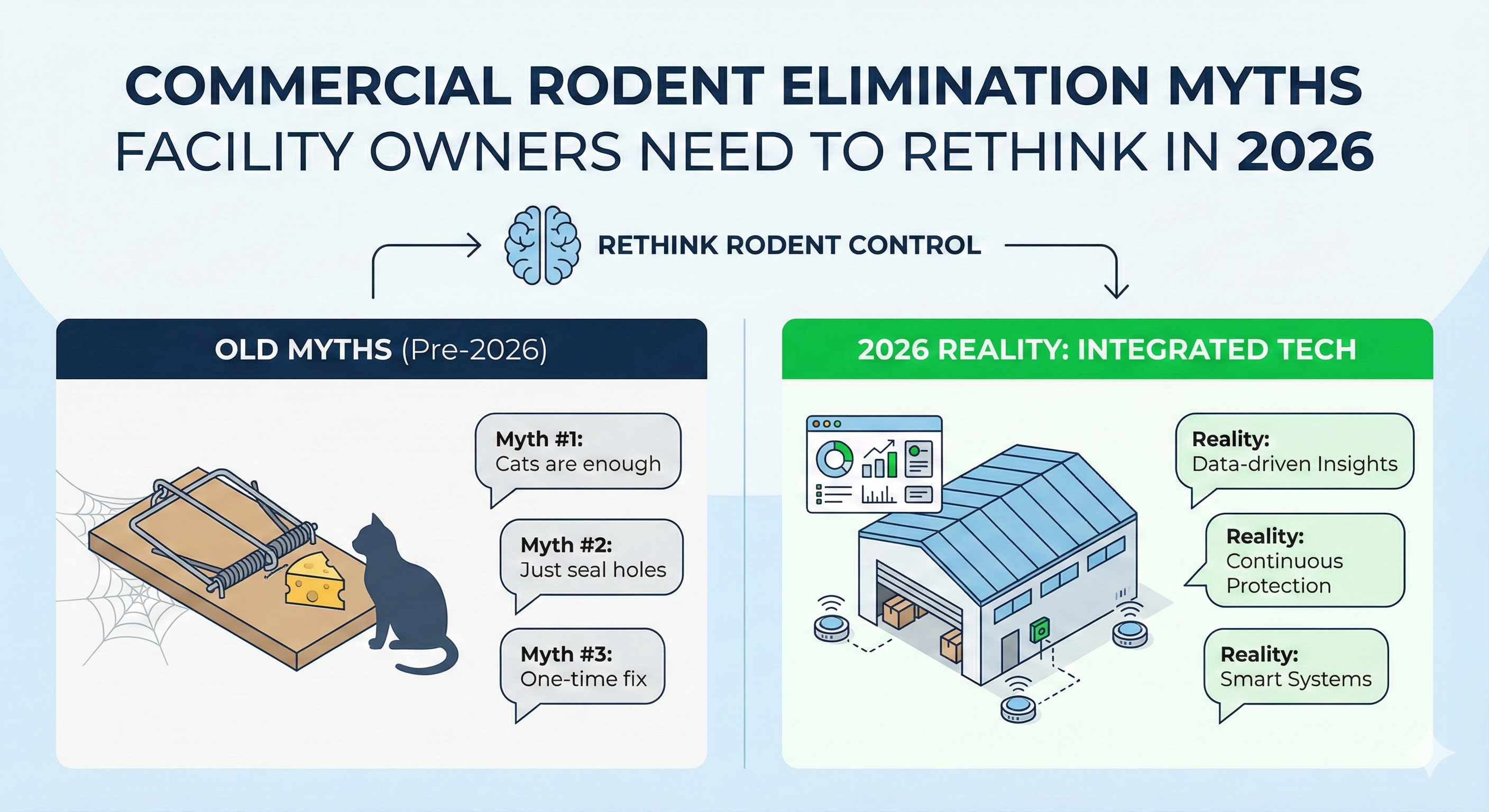
This article walks through the most expensive myths about commercial rodent elimination and how facility leaders can replace them with safer, 2026-ready strategies built around Strike System’s seismic and ultrasonic deterrent solutions.
Table of Contents
- Why rodent myths cost facilities money and uptime in 2026
- What “non toxic rodent control for large facilities” really means
- Myth 1: more poison means better commercial rodent elimination
- Myth 2: rodents are a housekeeping issue, not a strategic risk
- Myth 3: what works in homes works in 500 000 sq ft facilities
- Myth 4: elimination is a one-time event, not an ongoing strategy
- How Strike System replaces myths with safe, facility-wide control
- FAQ: commercial rodent control, non toxic options and 2026 strategies
Why rodent myths cost facilities money and uptime in 2026
If you manage warehouse rodent control or pest control large spaces, you are managing far more than an image issue. In big commercial and industrial facilities, rodents can:
- Contaminate food, packaging and ingredients
- Chew wiring and cabling that support automation and IT
- Damage insulation and infrastructure in hard-to-access voids
- Trigger failed audits under HACCP, BRC, SQF and similar schemes
- Force production stops during cleanups or regulatory investigations
A severe rat infestation in a distribution center or manufacturing site can lead to:
- Product holds or recalls
- Shutdowns ordered by regulators or customers
- Contract loss with major retailers or brands
- Long term brand damage if infestations become public
Traditional reaction tends to be “call the pest company, add more bait boxes.” In 2026 that approach is increasingly out of step with:
- Stricter customer and retailer requirements on chemical use
- Investor and ESG pressure to reduce toxic inputs
- Employee expectations for healthier workplaces
Strike System positions itself as a partner for non toxic rodent control in large facilities. Using Italian-engineered seismic vibration and ultrasonic technologies, it focuses on deterring rodents from occupying and nesting in critical infrastructure, rather than relying primarily on poisons.
For facility owners, that shift from “kill more” to “keep them out, safely” is the key to reducing risk, protecting uptime and passing audits.
What “non toxic rodent control for large facilities” really means
Non toxic rodent control for large facilities is a prevention-focused approach that manages rats and mice without relying on chemical rodenticides. In practice, it combines:
- Physical exclusion and proofing
- Sanitation and waste management
- Non chemical technologies, such as seismic and ultrasonic deterrents
- Where needed, mechanical or humane rodent traps for commercial sites
The goal is to keep rodent pressure low and prevent nesting in the building envelope, while protecting staff, products and the environment from exposure to poisons.
With that foundation in mind, let us look at the myths that keep many facilities stuck in outdated programs.
Myth 1: more poison means better commercial rodent elimination
When auditors or executives see a rat on a camera, the instinct is often simple: buy more bait, add more stations, “hit them harder.”
For large, complex sites, this “more poison” mindset has serious limits and risks.
Operational and safety risks of heavy rodenticide use
- Staff exposure
Spilled bait or misused products can expose technicians, cleaners or line workers to toxic compounds. - Product and packaging risk
In food and pharmaceutical environments, dropped or tracked bait can compromise product integrity and trigger holds. - Audit and compliance findings
Overuse or poor placement of toxic baits can violate label requirements or internal policies, leading to findings during HACCP or third-party audits. - Secondary effects
Poisons can harm non target animals if mismanaged and may enter waste streams. Many organizations are under pressure to limit this.
Non toxic and humane alternatives
Facilities now have access to non toxic rodent control and humane rodent traps designed for commercial use, along with deterrent technologies that make your building less attractive to rodents in the first place.
Strike System focuses on deterrence through:
- Seismic vibration
Devices emit carefully calibrated micro vibrations through building structures, making nesting areas uncomfortable for rodents without affecting equipment or people. - Ultrasonic deterrence
Networked ultrasonic emitters create variable sound fields in rodent hearing ranges. This disrupts communication and comfort, encouraging rodents to relocate.
These systems are:
- Silent for humans
- Compatible with sensitive environments like labs, data centers and clean storage
- Designed for continuous operation with minimal maintenance
They do not rely on killing rodents with poisons, which helps protect staff, products and audits from many traditional risks.
A practical comparison: poison vs seismic / ultrasonic deterrence
| Factor | Rodenticide-heavy programs | Strike System seismic & ultrasonic deterrence |
|---|---|---|
| Primary method | Kill rodents with toxic baits | Make areas unattractive so rodents move away |
| Risk to staff / products | Higher, due to chemical exposure | Very low, no chemical agents used |
| Impact on audits | Can raise concerns if mismanaged | Aligns with reduced-chemical, HACCP-based goals |
| Coverage in complex structures | Limited to bait station locations | Reaches hidden voids via vibration and sound |
| Long term effect | May create “bait dependent” programs | Supports sustained low pressure with prevention |
Chemical tools may still be used in specific contexts, but they no longer have to be the core of your commercial rodent elimination strategy.
Myth 2: rodents are a housekeeping issue, not a strategic risk
It is easy to frame rodents as a “cleaning problem” for the night shift. In a 500 000 square foot warehouse, however, mice and rats are not primarily about housekeeping. They are an operational and compliance exposure.
Why this myth is costly for warehouses and industrial sites
When leadership treats rodents as a minor hygiene issue, several things happen:
- Maintenance and operations teams under-report sightings
- Capital projects ignore rodent proofing details
- Budgets favor minimal “check the box” service instead of prevention
For warehouse rodent control and mice control warehouses, the result is often chronic low-level activity that occasionally explodes into a visible severe rat infestation.
In sectors governed by food safety and HACCP-based systems, rodents are a defined hazard. According to guidance from leading commercial providers, effective programs include inspection, monitoring and corrective actions that align with HACCP principles and customer standards. External resources such as https://www.ecolab.com/offerings/commercial-rodent-elimination-services highlight the need for site-specific, documented controls that go far beyond cleaning alone.
Strategic risks linked to rodents
- Food safety and HACCP audits
Rodent evidence can lead to critical findings, forced product holds and even decertification. - Brand and customer trust
Retailers and brand owners expect tight pest controls. A social media post about rats in a DC can damage relationships overnight. - Electrical and operational reliability
In manufacturing, data centers and logistics hubs, rodents chew insulation and cables, contributing to fires, outages and unexplained downtime. - Shutdowns and rework costs
A single shutdown for sanitation and structural repair can cost more than several years of a robust, proactive program.
How Strike System approaches risk-based site assessment
Rather than treating rodents as a cleaning failure, Strike System’s approach starts with a risk-based assessment that focuses on:
- Site layout and construction type
- Neighboring land use and external pressure
- Critical assets and zones, such as control rooms, server rooms, packaging lines and cold storage
- Existing proofing quality and known weak points
This type of assessment, similar in spirit to practices used by established industrial pest providers, is tailored to large buildings and integrated with your operational priorities. The result is a facility-wide plan that moves rodents into the category where they belong: a managed operational risk, not a recurring housekeeping surprise.
Myth 3: what works in homes works in 500 000 sq ft facilities
Many decision makers first learned about rodent control at home. Snap traps, hardware-store ultrasonic units, DIY sealants and peppermint oil are familiar tools.
Transferring those habits directly into rodent control for large facilities is one of the most common, and expensive, mistakes.
How large facilities differ from homes
- Scale
A single-family home may have a few key entry points. A modern distribution center or factory can have hundreds. - Structural complexity
Industrial buildings have long cable runs, suspended ceilings, process pits, conveyor tunnels and service voids that are rarely fully mapped. - Throughput and people flow
Dozens of dock doors cycle constantly, and thousands of pallets and people move daily. Every movement can create new harborages or temporary entry points. - Regulatory scrutiny
Homes do not undergo unannounced third-party audits or customer inspections that can be failed due to a single rodent dropping.
Effective rodent control in large facilities must be engineered around these realities. What works in a kitchen cupboard rarely scales to a 500 000 square foot plant or fulfillment center.
Key weak points in large spaces
Whether you work in warehouses, food processing or industrial manufacturing, certain areas are consistently vulnerable.
Bullet checklist of priority entry and pressure points:
- Loading dock doors and dock levelers
- Door seals and thresholds on personnel doors
- Gaps around conduits, pipes and cable penetrations
- Utility entry points, including water and gas lines
- Roof vents, louvers and damaged bird screens
- Floor drains and service trenches
- Trash compactors, dumpsters and outdoor storage areas
- Pallet storage near walls or structural columns
- Mechanical rooms, boiler rooms and pump houses
Resources such as https://wildlifeworksllc.com/warehouse-rodent-control/ and other industry sources emphasize how these structural and operational details drive infestations in large buildings. See also: https://rodentsstop.com/warehouse-rodent-control-solutions/.
Strike System vs residential-style providers
Many traditional pest providers built their businesses around residential work, then added commercial accounts. Techniques and tools sometimes carry over without enough adaptation.
By contrast, Strike System is designed specifically for complex commercial and industrial environments. Its seismic and ultrasonic systems are installed:
- Along structural beams, cable trays and walls
- In roof voids and utility areas where traps and bait are hard to maintain
- Around critical infrastructure zones such as data rooms or packaging lines
The objective is to create a consistent, facility-scale deterrent layer that aligns with your building’s engineering, not just spot treatments copied from home solutions.
Myth 4: elimination is a one-time event, not an ongoing strategy
When a severe rat infestation finally becomes too visible to ignore, the response is often a “project mindset”: hit hard for a month, declare victory, move on.
In real facilities, rodent pressure changes with:
- Season and outdoor temperature
- Neighboring construction or demolition
- Changes in waste handling or raw materials
- New conveyor lines, walls or mezzanines
Treating rodent elimination as a one-time event ignores this constant evolution.
A more realistic pattern for warehouses and plants
High-performing programs in warehouses and industrial sites usually follow this pattern:
- Initial knockdown
Intensive trapping or other methods to quickly reduce existing populations. - Structural and behavioral corrections
Proofing, sanitation improvements, dock door adjustments and waste handling changes. - Installation of long-term controls
Deterrent systems, monitoring devices and a documented inspection plan. - Weekly or regular inspections
Technicians physically check key zones, adjust controls and remove any captures. - Trend analysis and reporting
Data on sightings, captures and conditions is reviewed to identify hotspots before they spike. - Continuous improvement
As the site layout changes, the program is updated rather than reset only after a crisis.
Data-driven control and continuous monitoring
Many facility leaders now expect:
- Digital reporting they can review before customer visits
- Maps of activity and conditions, not just “all good” notes
- 24 / 7 support or remote assistance when something changes unexpectedly
Strike System technology fits into this proactive model by providing continuous, non toxic deterrence in the background. Networked controllers and adaptive frequency patterns help keep rodents from re-establishing themselves in protected zones, while your pest management and facilities teams focus on inspections, proofing and documentation.
Instead of cycling between “all quiet” and “emergency infestation,” you get a stable, monitored, low-activity state that aligns better with modern quality systems. For related facility-wide approaches, see: https://www.ecolab.com/solutions/pest-solutions-for-buildings-and-facilities.
How Strike System replaces myths with safe, facility-wide control
If you have been using heavy rodenticides, residential-style hardware or purely reactive service, it can be hard to picture what a safer, 2026-ready solution looks like.
Strike System’s approach is built around non toxic, technology-driven deterrence at industrial scale, combined with the structural and operational controls you already expect from professional programs.
Summary of how it addresses severe infestations and ongoing risk
For sites facing a severe rat infestation, Strike System works with your existing pest provider or internal teams to:
- Support initial population reduction with compatible methods
- Identify and prioritize the highest-risk structural zones
- Design a seismic and ultrasonic deterrent layout that covers those zones
- Integrate deterrent devices with practical proofing and housekeeping steps
- Provide documentation that supports audits and stakeholder communication
The goal is long term rodent pressure reduction without introducing new chemical risks to staff, products or critical systems.
Step-by-step checklist: from assessment to monitoring
Every facility is different, but a typical Strike System engagement follows a clear sequence:
- Site discovery and risk review
- Review site maps, past pest reports and audit findings
- Clarify critical zones such as food processing areas, labs, racks, server rooms or control centers
- On-site technical assessment
- Walk the building envelope, docks, roof lines and utility rooms
- Inspect for droppings, gnaw marks, rub marks and harborages
- Document structural conditions and existing pest equipment
- System design and proposal
- Map seismic and ultrasonic device locations for optimal coverage
- Coordinate with existing traps or humane rodent traps for commercial use where necessary
- Align with HACCP zones and customer or retailer expectations
- Installation and commissioning
- Install vibration and ultrasonic units with minimal disruption to operations
- Configure adaptive frequency patterns appropriate for your environment
- Test communication of networked controllers if applicable
- Integration with monitoring and reporting
- Define how pest technicians and facility staff will interact with the system
- Align checklists so inspections cover both physical conditions and deterrent hardware
- Set up data collection or reporting formats needed for audits
- Training and handover
- Train designated staff on basic system checks and escalation paths
- Provide documentation for quality, safety and environmental teams
- Ongoing optimization
- Review performance at agreed intervals
- Adjust coverage if the building layout, use or external risk profile changes
This structured flow is designed to be compatible with existing commercial pest solutions, not to replace everything you already do. The unique contribution is non toxic, silent, maintenance-light coverage in places that are difficult to protect with traditional methods alone.
Is Strike System the right eco mouse removal choice for your facility?
Many facility owners are explicitly asking: “What is the most eco friendly mouse removal for businesses that still protects our uptime and audits?”
For organizations that:
- Operate large, complex sites such as distribution centers, food plants, laboratories, data centers or industrial warehouses
- Want to reduce or eventually move away from heavy rodenticide use
- Need solutions that align with HACCP, CE, ISO and similar standards
- Value technologies that are silent, non disruptive and designed for continuous operation
Strike System offers a specialized, non toxic approach that merits serious consideration. It does not promise instant elimination, and it does not claim to be a one size fits all fix. Instead, it integrates engineered seismic and ultrasonic deterrence with the broader controls that your facility already relies on.
To explore what this could look like in your buildings, visit https://strikesystem.com/ and request a facility-specific assessment or technical discussion.
FAQ: commercial rodent control, non toxic options and 2026 strategies
What’s the most eco-friendly way to remove mice from a business without using poison?
The most eco friendly mouse removal for businesses usually combines three elements:
- Exclusion
Seal gaps, repair door sweeps, secure dock levelers and close openings around pipes and cables. This physically prevents entry. - Non toxic deterrence
Use technologies such as seismic vibration and ultrasonic systems in high risk zones to discourage mice from nesting in the building envelope. Strike System focuses on this layer for warehouses, plants and critical infrastructure sites. - Mechanical or humane trapping
Where animals are already inside, mechanical traps or humane rodent traps designed for commercial use can quickly remove individuals without chemicals.
This combination minimizes environmental impact, protects staff and product safety, and creates a sustainable defense rather than a constant cycle of poison use.
Do ultrasonic repellents or peppermint oil actually work for commercial mouse control, or are they myths?
Consumer ultrasonic devices and peppermint oil are often oversold as stand alone solutions. In large commercial settings:
- Peppermint oil
Can have a mild, short-lived effect in very small spaces, but it dissipates quickly and is not practical or reliable at scale. - Simple plug-in ultrasonic gadgets
May have limited range and fixed frequencies that rodents get used to. Coverage gaps are common in high bay warehousing and industrial layouts.
Engineered ultrasonic systems can be effective when:
- They are part of a designed layout that accounts for building geometry and materials
- Frequencies and patterns vary over time so rodents cannot easily adapt
- They are integrated with other controls like exclusion, cleaning and monitoring
Strike System’s ultrasonic and seismic solutions were developed for large, complex buildings, not living rooms, and are installed based on a site-specific assessment rather than simple plug-and-play use.
Should a facility use live traps for mice, and what are the legal/ethical issues with relocating them?
Live traps can be part of a humane strategy, but commercial users should consider:
- Legal considerations
Local regulations may restrict relocation of captured rodents, since moved animals can spread disease or become pests elsewhere. Always check applicable rules. - Practicality
In a 500 000 square foot facility, manually checking and relocating from many live traps can be labor intensive and may not keep pace with rodent reproduction. - Animal welfare
Live traps require frequent checks so animals do not suffer from stress, dehydration or exposure before release or humane handling.
Many businesses therefore opt for humane, quick-kill mechanical traps in critical zones, combined with non toxic deterrent systems that reduce the number of animals entering in the first place.
How much does professional rodent-proofing cost for a commercial building, and is it worth it versus ongoing trapping?
Costs vary widely based on building size and construction type, existing damage and number of access points, and whether work involves doors and docks only or also wall penetration, roofing and utility chases.
While it is not possible to give a meaningful number without a site visit, experience across the industry shows that good proofing significantly reduces the number of rodents entering. Fewer entries mean less trapping, fewer emergency cleanups and a lower chance of audit failures.
Over time, effective proofing and prevention typically cost less than relying solely on constant trapping and reaction. For additional industry context on commercial programs and inspections, see https://www.trulynolen.com/commercial/industrial-buildings and https://www.usxpest.com/commercial-industries/manufacturing-pest-control/.
What’s the best way to prevent mice in a restaurant/warehouse (doors, loading docks, dumpsters) without heavy chemical use?
Key steps that apply to both restaurants and warehouses include:
- Strengthen the building envelope
- Seal gaps under doors and install quality sweeps
- Repair torn screens and damaged dock seals
- Close openings around utility lines with appropriate materials
- Manage waste and food sources
- Use sealed containers and keep lids closed
- Schedule regular cleaning around dumpsters and loading areas
- Address spills promptly in production or storage zones
- Reduce harborages
- Keep items off the floor and away from walls
- Rotate stock and avoid long-term dead storage in dark corners
- Maintain vegetation and debris control around the perimeter
- Add non toxic deterrents
- Deploy seismic and ultrasonic systems in back-of-house areas, storage zones, ceiling voids and dock corridors where rodents often move and nest.
Together, these measures can significantly reduce reliance on rodenticides while still protecting food safety and operations.
If we stop using rodenticides, will mice populations rebound, and how do we keep long-term control in a facility?
If a facility simply stops using poisons and does nothing else, populations can rebound. The key is to replace chemical reliance with a structured, multi-layered program:
- Strengthen exclusion and building maintenance
- Improve sanitation and waste handling to reduce attractants
- Install non toxic deterrent technologies like seismic and ultrasonic systems to keep pressure low
- Maintain a monitoring cycle with regular inspections and data review
This approach changes the facility from a high risk, “bait dependent” site to one where conditions are less favorable for rodents in the first place. With proper design and follow-through, many large facilities maintain long term control with little or no routine rodenticide use.
For facilities ready to rethink their 2026 rodent strategy, engaging with a specialized non toxic provider such as Strike System at https://strikesystem.com/ is a practical next step toward safer, more sustainable control.