
Most rodent problems get treated the same way: set traps, apply bait, wait. The species rarely gets a second thought. But a rat compares to a mouse the way a jackhammer compares to a penknife — same family, completely different profile.
Each one enters buildings differently, breeds at a different rate, and responds to control measures differently. Knowing which rodent has moved in is the first decision that makes every response after it work.
Key Takeaways
- Rats and mice differ in six measurable ways — from body proportion to dropping shape — and each clue narrows the ID.
- There is one physical tell that separates a juvenile rat from an adult mouse every time.
- The two most common rat species in industrial buildings occupy completely different levels of a structure.
- Misidentification leads to wasted resources and, in regulated facilities, can trigger compliance failures.
- Neither poison nor traps are required to eliminate either species permanently.
Does It Actually Matter Which One You Have?
Yes. The species determines how you respond at every level.
Rats and mice enter buildings through different gap sizes. Mice can squeeze through an opening as small as a quarter inch, and rats need at least half an inch, but their jaw strength means soft sealants alone will not hold them back.
Trapping strategies differ, too. Mice are curious and will investigate new objects quickly. Rats are wary of anything unfamiliar and may avoid a fresh trap for days before approaching.
The reproductive scale adds urgency to accurate identification:
- A female mouse can produce 300+ offspring in her lifetime, with young reaching breeding age in as little as four weeks.
- A pair of rats can generate an estimated 2,000 descendants within a single year.
In industrial environments, from food manufacturing plants to data centers, the wrong identification leads to the wrong response. And in regulated facilities, a failed response carries compliance consequences that go far beyond a pest problem.
How Do You Tell the Difference Between a Rat and a Mouse?
Six physical traits mark this distinction clearly. However, you rarely need all six. Two or three will confirm what you’re dealing with.
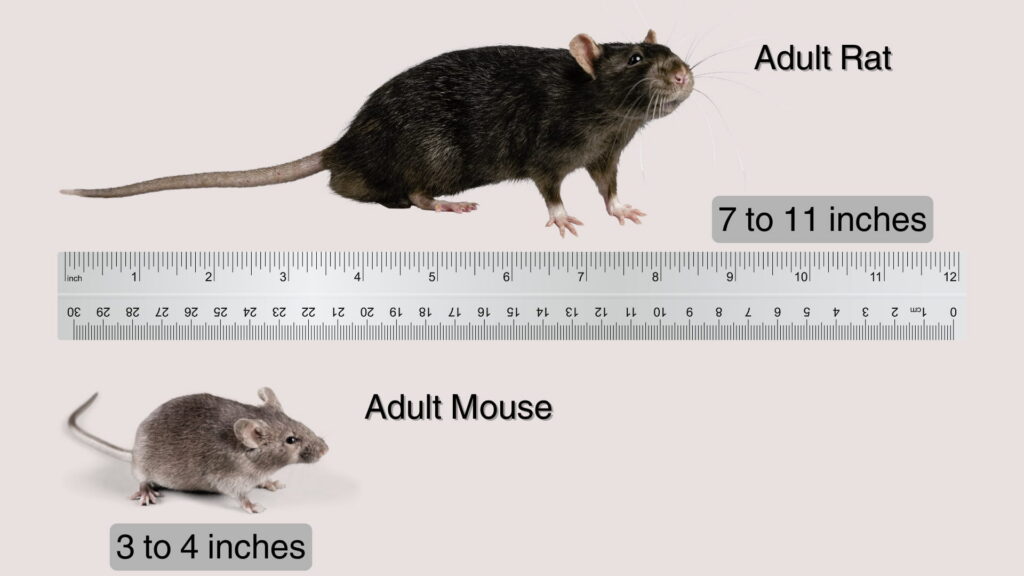
Size
- Adult mice run 3 to 4 inches in body length and weigh under an ounce.
- Adult rats reach 7 to 11 inches and can weigh close to a pound.
That gap is unmistakable when both are fully grown.
Juveniles complicate it. A young rat and an adult mouse can be nearly the same length. The reliable tell is proportion: a juvenile rat’s feet and head look oversized for its body. An adult mouse’s proportions are balanced and trim. That detail holds regardless of age or lighting.
Head and Face
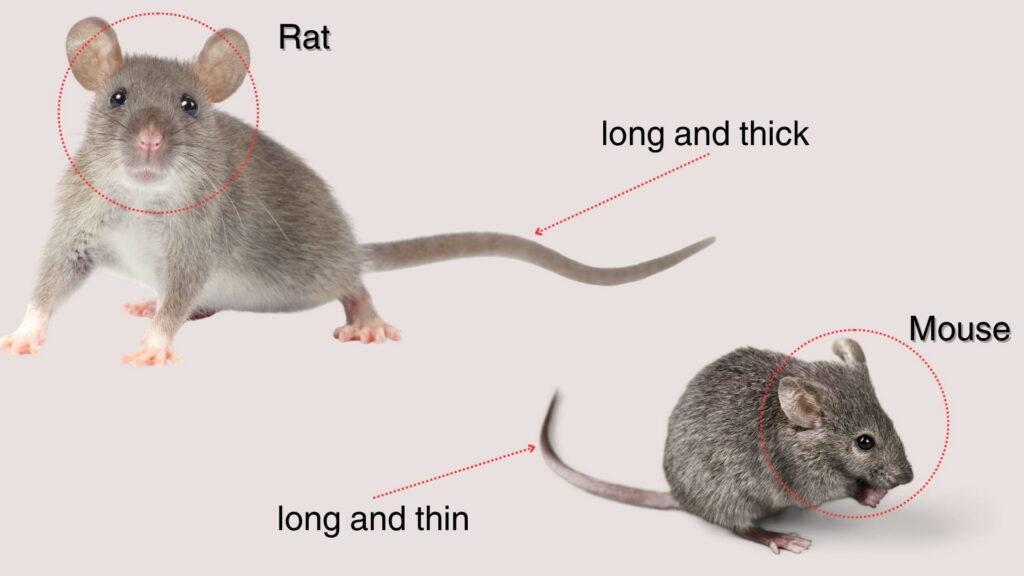
Mice have triangular snouts, large, round eyes, and notably large, floppy ears. The overall look is angular and alert.
Rats appear blunter. Their snout is rounded, their eyes look smaller relative to the head, and their ears sit close and flat against the skull. Norway rats have a heavy, wide-set facial structure. Roof rats are more slender-faced but still noticeably blunter than any mouse.
Tail
Mouse tails are thin, long relative to body length, and lightly covered in fine hair.
Rat tails are thick, hairless, and scaled. Norway rat tails are shorter than the body; roof rat tails exceed body length. Thickness is usually the fastest visual read when you only catch a brief look.
Droppings
Droppings are often the first physical sign of a rodent presence, and reliable enough to make a species call before you ever see the animal directly.
| Mouse | Norway Rat | Roof Rat | |
| Size | ~¼ inch | ½–¾ inch | ~½ inch, thinner |
| Shape | Pointed ends, rice-like | Blunt, brick-shaped | Slightly curved, pointed ends |
| Quantity per day | 50–75, scattered widely | Far fewer, concentrated | Far fewer, inconsistent locations |
| Typical location | Along travel paths, near nesting | Floor-level, burrow entrances | Elevated areas: rafters, ceiling voids |
Mice produce substantially more droppings per day than rats. A wide scatter pattern across multiple rooms signals mice. Concentrated deposits in one or two spots suggest rats. Always use PPE when inspecting or clearing droppings; several rodent species carry pathogens transmissible through contact with waste.
Movement and Nesting
A mouse’s range is tight, roughly 10 to 30 feet from its nest. Nests are built from shredded paper, fabric, or fibrous insulation inside wall cavities, behind equipment, or within insulated panels near food sources.
Rats travel farther. Norway rats stay near floor level, following walls and baseboards, and tend to burrow under foundations, concrete slabs, and loading dock perimeters. Roof rats do the opposite — they climb. Cable trays, overhead pipe runs, drop ceilings, and attic voids are their preferred zones.
One rat-specific sign: rub marks. Greasy fur leaves dark, oily smudges on surfaces that rats travel repeatedly. Mice leave no equivalent.
Damage Signature
- Mouse gnaw holes are roughly dime-sized with small, clean tooth marks.
- Rat openings are quarter-sized or larger, with rough, splintered edges from sustained chewing.
Rats work through harder materials: concrete, lead pipe, and soft metals. Mice typically stay with wood, soft plastics, and food packaging.
Frayed wiring or rough-edged holes in drywall point toward rats. Fine scratches and small perforations suggest mice.
Entry hole size also guides exclusion work. Gaps the size of a dime need to be sealed against mice. Larger openings require rodent-proof materials such as steel wool, hardware cloth, or sheet metal. Foam and caulk alone will not hold against a determined rat.
Which Species Are You Most Likely Dealing With?
Four species account for the vast majority of rodent infestations in commercial and industrial buildings.
Among the types of mice, the house mouse (Mus musculus) is the most common indoor species by a wide margin. The deer mouse appears less often but matters in specific contexts: it favors grain storage facilities, distribution centers, and agricultural warehouses, and is a documented carrier of Hantavirus.
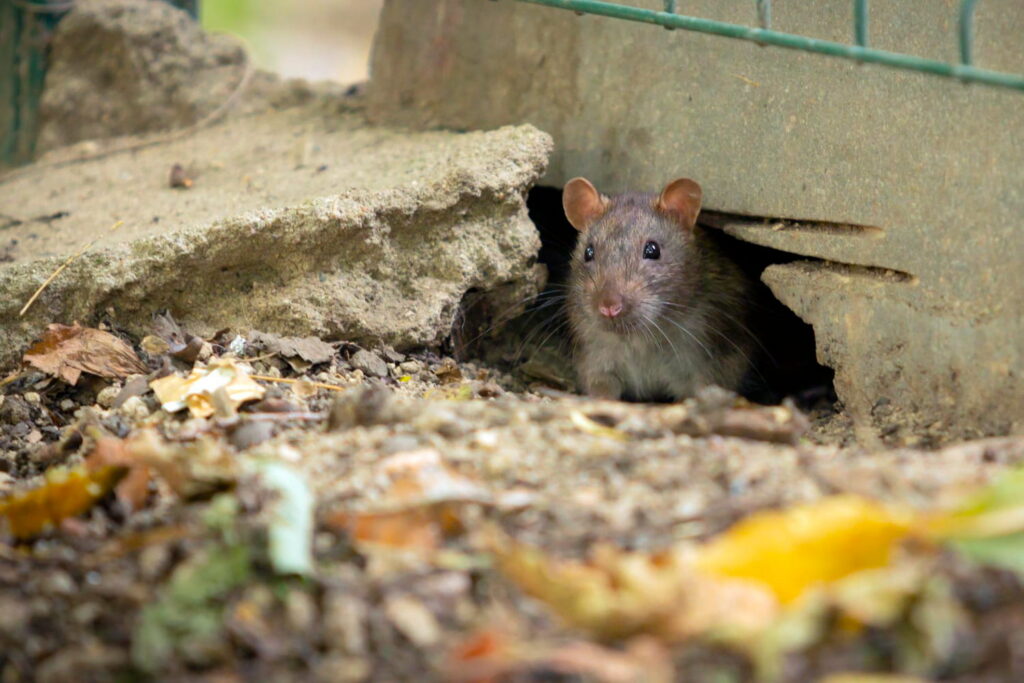
On the rat side, two species dominate:
- Norway rat (brown rat): the default urban rat, heavy-bodied, found near drainage systems, sewer access points, and perimeter foundations. Most prevalent in food processing and manufacturing facilities.
- Roof rat (black rat): slender, fast-climbing, and strongly associated with port-adjacent warehouses, data centers, and multi-story facilities. Its preference for electrical infrastructure makes it a particular liability in cable-dense environments.
Knowing the species shapes where you look, what signs you prioritize, and how you approach prevention. The rat or mouse question is the first filter. Species identification is the second.
Where Does Traditional Pest Control Fall Short After Identification?
Knowing the species narrows the problem. This is where industrial pest control programs most often break down: not at identification, but at the response that follows.
Traps and bait stations address individual animals, not the population behind them. A colony replenishes faster than a trap line can clear it.
Chemical rodenticides create a separate set of problems in regulated environments. In food processing, pharmaceutical production, and any facility operating under HACCP compliance, poison-based control carries regulatory exposure.
Rodenticides also carry secondary poisoning risk: the compound passes through the food chain, creating additional liability where other animals or wildlife are present near the facility. Beyond that, rodenticides produce dead animals somewhere inside the structure: wall cavities, ceiling voids, ductwork. Locating them is not always possible. The contamination and odor that follow are their own operational problem.
Is There a Deterrence Approach That Works for Both?
Yes. The flight instinct that seismic and ultrasonic systems activate is not species-specific. It is hardwired into every rodent.
Our TRANSRAT Series transmits seismic micro-vibrations through building structures, creating conditions that rodents register as unstable ground. The US2004 Series delivers adaptive ultrasonic frequencies designed to prevent habituation and maintain continuous deterrence across large areas. Both series cover facilities up to 100,000 square feet, carry IP67 and CE certification, and are engineered for a 20-year operational lifespan with zero maintenance required.
For facilities under HACCP requirements or operating in sensitive production environments, both series are fully chemical-free, producing no dead animals, no residual odor, and no secondary contamination.
Identification tells you what you’re dealing with. The right industrial pest control system ensures it does not come back. Request a free site assessment to get a custom system design for your facility.
FAQ
Yes, and it is one of the most common misidentification errors. Both can be similar in length, but a juvenile rat’s feet and head are disproportionately large for its body, where an adult mouse’s proportions are uniformly balanced.
The difference between rats and mice extends to where they settle: Norway rats near ground level, roof rats in elevated infrastructure, mice in wall cavities near food sources. In large facilities, all three can be active in entirely separate areas at the same time.
Yes. Rats are dominant and tend to displace mice from shared spaces, so both species typically settle in separate zones of a larger building, meaning an infestation may require deterrence across multiple areas simultaneously.
Faster than most inspection schedules catch it. Mice reach reproductive maturity in as little as four weeks, meaning a small population can develop into a full infestation between routine assessments.
Yes. The flight response that both technologies activate is the same across all rodent species, making these systems reliable regardless of which species has been identified in the facility.