
Here is the uncomfortable truth: most industrial sites do not have a rat-removal problem. They have a rat-prevention failure.
For food plants, data centers, laboratories, military sites, and high-throughput warehouses, the strongest long-term solution in 2026 is often prevention-led seismic rodent deterrence, not more poison, more traps, or more service visits.
This guide compares the main industrial rat-control options, explains where each fits, and shows why Strike System is often a strong choice for sensitive, always-on environments.
Quick answer: For large, regulated, or nonstop facilities, seismic rodent deterrence is often the best overall solution because it helps prevent rodent travel and nesting continuously without poison, dead rodents, or high-touch servicing.
- Best fit for many industrial sites: seismic rodent deterrence designed around the building layout.
- Why it wins: broad structural coverage, no poison, no carcass recovery, and low recurring maintenance.
- What still matters: exclusion, sanitation, and monitoring remain essential layers.
- What buyers should compare: coverage, labor burden, contamination risk, compliance fit, and total cost of ownership.
What is the best rat solution for large industrial facilities?
For large, regulated, or nonstop facilities, seismic rodent deterrence is often the best overall solution because it helps prevent rodent travel and nesting continuously without poison, dead rodents, or high-touch servicing.
That does not mean traps, exclusion, sanitation, or service programs are useless. It means repeated removal alone is usually the wrong primary strategy at industrial scale. Large sites rarely win by killing faster. They win by making the structure harder to use in the first place.
Definition: what is seismic rodent control?
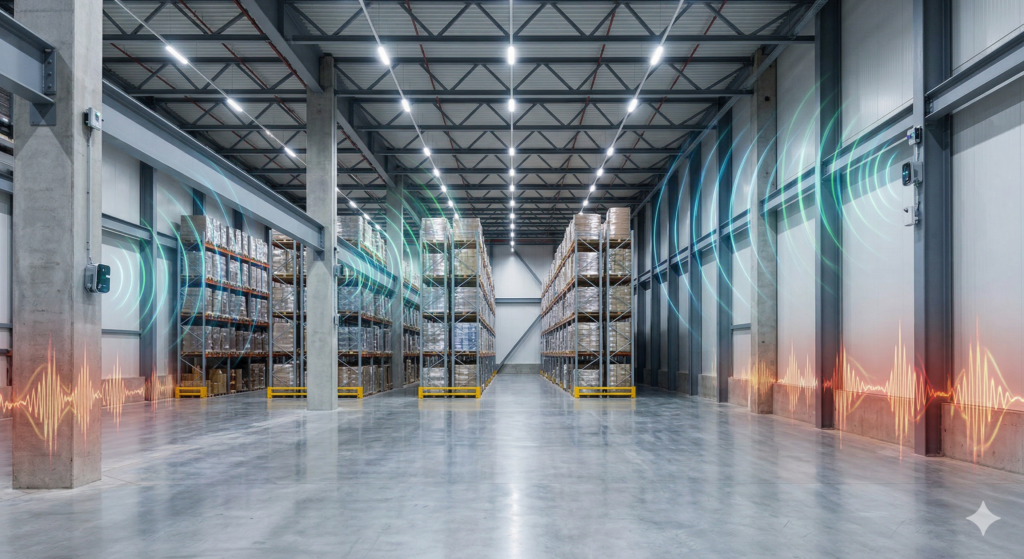
Seismic rodent control uses controlled structural vibrations to discourage rodent travel and nesting in hidden spaces.
Unlike ultrasonic devices, which project sound into open air, seismic systems work through structural elements such as floors, slab areas, and walls. That makes them especially relevant where rodents move out of sight rather than across open floors.
At industrial scale, the real threat is rarely the rat you see. It is the movement you do not.
Why industrial rat control is different
Small buildings can get by with occasional removal. Large facilities need continuous environmental control.
In industrial environments, rodent pressure is amplified by size, hidden pathways, constant movement, dock activity, utility penetrations, and hard-to-access infrastructure. The result is not just a pest issue. It is an operations issue.
That means the real business risks include:
- Product contamination
- Cable and insulation damage
- Sanitation failures
- Downtime and labor burden
- Audit exposure
- Reputational harm
The CDC guidance on rodent control and health risks reinforces the obvious point many facilities learn too late: rodents are not a housekeeping nuisance. They are a health and operational threat.
What makes large-scale rat removal difficult
Industrial sites combine four things rodents love: scale, concealment, complexity, and constant change.
Common pressure points
- Wall voids and slab edges
- Utility penetrations and cable pathways
- Loading docks and door thresholds
- Mechanical rooms and service corridors
- Dense storage and equipment perimeters
Most industrial buyers evaluate rodent-control options using practical criteria, not marketing language:
- Coverage area
- Continuous operation
- Maintenance burden
- Contamination risk
- Compliance and sanitation fit
- Installation complexity
- Total lifecycle cost
Best large-scale rat control methods compared
| Method | Best For | Main Limitation |
|---|---|---|
| Rodenticides | Exterior perimeters and select non-sensitive zones | Poison exposure, carcass recovery, contamination, audit concerns |
| Mechanical traps | Localized removal and activity confirmation | Labor-heavy and difficult to scale |
| Exclusion and sanitation | Foundational risk reduction | Essential, but rarely sufficient alone in dynamic sites |
| Fertility control | Longer-term population reduction | Slow impact and limited immediate protection |
| Service contracts | Monitoring, reporting, and compliance support | Often reactive between visits |
| Ultrasonic systems | Defined enclosed spaces | Placement-sensitive and limited by obstructions |
| Seismic systems | Large, sensitive, always-on facilities | Performance depends on proper site-specific design |
How the main methods compare in practice
Rodenticides and bait stations
Best for exterior use and selected service areas. Indoors, especially in sensitive environments, poison can create as many problems as it solves. Carcass recovery, chemical handling, secondary exposure, and inspection concerns make rodenticides a weak interior fit for many facilities. See the EPA overview of rodenticides for regulatory context.
Mechanical traps
Best for targeted removal and verification. Traps are useful tactical tools. They are not a scalable whole-facility prevention strategy. If your footprint is massive and your pest plan depends on constant trap checks, you do not have a system. You have a treadmill.
Exclusion and sanitation
Best as the foundation. Sealing gaps, improving dock practices, reducing food sources, and tightening housekeeping are mandatory. But industrial environments change constantly. Doors cycle, equipment moves, penetrations appear, and new vulnerabilities open up. Exclusion is necessary, not magical.
Fertility control
Best as a supplement. Products such as ContraPest may help reduce reproduction over time, but they are not usually the answer when immediate structural protection is the priority.
Standard pest service contracts
Best for monitoring and documentation. Service programs matter, especially for reporting and compliance support. But rodents do not pause activity between technician visits. That is the gap prevention systems are meant to close.
Ultrasonic systems
Best for enclosed, line-of-sight spaces. Ultrasonic products can be useful in targeted zones, but they are usually a supporting layer rather than a whole-site answer.
Seismic vibration systems
Best for broad, continuous, non-toxic deterrence. Seismic systems send controlled vibration patterns through the structure itself, helping make protected areas less attractive for rodent travel and nesting. That is a serious advantage when rodents use hidden routes instead of open floor space.
Why seismic systems are often the best choice
Seismic systems address the hardest industrial problem: rodent activity inside inaccessible structural spaces.
Kill-based methods respond after activity is found. Seismic deterrence changes the environment first. Controlled micro-vibrations can create conditions rodents are less likely to use for movement and nesting, particularly in concealed pathways.
Operational advantages
- No poison inside sensitive zones
- No dead rodents in inaccessible spaces
- Broad structural coverage
- No bait or consumables to replenish
- Silent operation
- Low recurring maintenance
- Stronger fit for sanitation- and audit-sensitive environments
- Reduced labor burden compared with high-touch trapping programs
That is why seismic systems are especially compelling in food manufacturing, data centers, laboratories, and other critical environments. Food operations in particular often prefer preventive approaches that align with FDA preventive controls for human food.
Where seismic systems work best, and where they need support
Good technology is not magic. Good design is what makes it useful.
Seismic deterrence tends to perform best in facilities with large structural footprints, hidden travel routes, high sanitation requirements, and a need for low-touch operation.
It should still be paired with:
- Exclusion to reduce ingress
- Sanitation to reduce attractants
- Monitoring to verify pressure and trends
- Targeted traps where activity needs confirmation or immediate removal
Performance can vary based on slab design, wall construction, floorplan complexity, equipment density, and risk-zone layout. In other words, installation design is not a footnote. It is the strategy.
What to look for in an industrial seismic rodent system
Not all seismic systems are built for enterprise use. The best industrial platform should offer:
- Large-area coverage
- Adaptive pattern variation
- Networked controls
- Industrial-grade enclosure protection
- Compliance and certification fit
- Site-specific design support
- Documented installation methodology
- Clear maintenance expectations
- Defined lifespan and deployment guidance
Why Strike System stands out
Strike System is built for facilities that care more about uptime, sanitation, and structural protection than kill counts.
According to the company’s published product information, Strike System combines Leonardo Soluzioni technology with North American site-specific design support. Stated features include:
- Installations covering up to 100,000 square feet
- 12 million vibration patterns
- IP67-rated equipment
- Maintenance-free design
- Stated 20-year lifespan
- Tailored layout and deployment support
Technical details are available on the company’s Strike System seismic and ultrasonic products page.
The bigger advantage is not just hardware. It is the combination of broad coverage, adaptive signaling, durable equipment, and site-fit implementation. In industrial pest control, that combination matters more than flashy specs in isolation.
Best-fit facilities for Strike System
Food processing and storage: supports preventive pest management without creating carcass-recovery issues in hard-to-access areas.
Data centers: helps protect cable pathways and critical infrastructure with silent, low-touch deterrence.
Medical, laboratory, and pharmaceutical spaces: fits controlled environments that prioritize sanitation and non-toxic methods.
Military and government facilities: offers discreet, durable protection with less dependence on frequent service visits.
Warehouses, agriculture, and high-rise infrastructure: provides broad structural coverage where dock activity, concealed routes, and large footprints make traps and bait harder to manage.
How to build a modern industrial rat strategy
The most effective approach is layered: exclusion as the base, monitoring as verification, and seismic deterrence as the continuous prevention layer.
Start with a site assessment. Identify ingress points, pressure zones, structural vulnerabilities, and operational constraints. Improve sanitation and exclusion where practical. Then design the deterrent layer around the actual floorplan, not a generic coverage assumption.
Questions procurement teams should ask
- What area can the system realistically cover in this layout?
- How is the design adapted to this facility?
- What certifications or enclosure ratings apply?
- What maintenance, if any, is required?
- How does the system support sanitation, audits, and uptime?
- What is the expected lifecycle cost compared with traps, bait, and service labor?
Delay is expensive. The longer rodents move unseen, the greater the risk of contamination, damage, service costs, and audit exposure.
If your team is evaluating options now, request a free assessment. You can also review Strike System’s industries, products, about, and industrial rodent control technology pages.
FAQ
What is the best large-scale rat solution for industrial facilities?
For many industrial facilities, the best solution is a prevention-based seismic rodent deterrent system. It provides continuous structural deterrence and is often a stronger fit than poison or trap-only programs in large, regulated, always-on environments.
How do seismic rodent deterrent systems work?
They send controlled micro-vibrations through floors, walls, and structural elements. These changing patterns can make protected areas less attractive for rodent travel and nesting.
Are seismic systems better than poison or traps for food facilities?
In many food facilities, yes. They can reduce carcass issues, chemical-handling concerns, and recurring service burden while supporting preventive pest-management goals.
Do seismic systems work in concrete and steel buildings?
They can, but performance depends on site-specific design. Structural materials, slab layout, wall construction, and risk-zone placement all affect how a system should be deployed.
Can rats get used to vibration-based deterrents?
Adaptive pattern variation is designed to reduce habituation risk. That is why buyers should look for systems with changing signal patterns rather than static output.
Are seismic systems a replacement for traps and exclusion?
No. The strongest programs are layered. Exclusion reduces entry, sanitation reduces attractants, monitoring verifies activity, and seismic deterrence provides continuous structural prevention.
Can warehouses and data centers use chemical-free rat deterrent systems?
Yes. These facilities are often strong candidates because they need broad coverage, low maintenance, and minimal operational disruption.
What is the difference between ultrasonic and seismic rat control?
Ultrasonic systems project sound into defined spaces, while seismic systems work through the structure itself. Seismic is often better suited to hidden pathways and broader structural coverage.
How much area can an industrial seismic system cover?
Coverage depends on layout and design. Strike System states that its platform can support installations covering up to 100,000 square feet.
Do seismic rat deterrent systems require maintenance?
Industrial-grade systems are typically low maintenance. Strike System states that its platform is designed for maintenance-free operation.
Can seismic rodent control support HACCP and audit-sensitive environments?
Yes. While no product guarantees compliance by itself, non-toxic deterrence can support preventive pest-management strategies in HACCP-oriented and audit-sensitive environments.
Conclusion: at industrial scale, prevention beats repeated removal
The best large-scale rat solution is the one that stops rodents before they settle, nest, and spread risk through your facility.
For many industrial sites, that means combining exclusion and sanitation with continuous seismic deterrence. Strike System is a strong option for organizations that want low-maintenance, industrial-grade rodent protection without adding poison, carcass recovery, or constant service friction.
If your facility is exposed today, waiting is not a neutral decision. It is a cost multiplier. Request a technical consultation or site-fit assessment to review your layout, risk zones, and coverage needs.